
Your WMS Knows Where the Product Is. But Is It in the Right Place?
A warehouse can be digital, structured and fully visible, and still be inefficient.
Inventory may be accurate. Receiving, putaway and picking processes may be controlled by a Warehouse Management System (WMS). Operators may use scanners, managers may monitor performance dashboards, and every product may have a defined storage location.
Yet employees can still spend a significant part of every shift walking farther than necessary.
The issue is not whether the system knows where a product is. The more important question is whether that product is positioned in the best possible place for the way the warehouse operates today.
The Hidden Cost of Movement
Order picking is one of the most labor-intensive warehouse activities, and movement is an unavoidable part of it. But not all movement creates value.
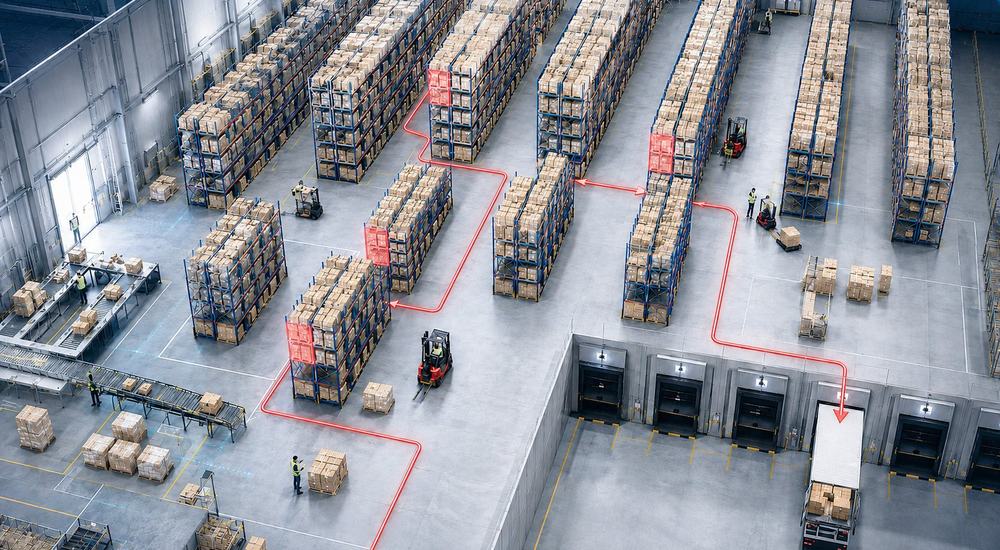
Every unnecessary aisle crossed, every return to a previously visited zone and every frequently picked item stored too far from dispatch adds time to the process. Repeated across hundreds or thousands of order lines, small inefficiencies become a measurable operational cost.
This cost is often difficult to see because there is no single visible failure. Orders are completed, products are found and shipments leave the warehouse. The process works, but it may require more walking, more labor and more time than it should.
That is why improving picking efficiency does not always begin with adding more people or investing in additional automation. Sometimes it begins by examining the relationship between product placement, order patterns and actual movement through the warehouse.
Why Product Placement Becomes Outdated
Warehouse layouts are rarely designed to remain optimal forever.
Product ranges change. New customers are added. Seasonal demand shifts. Promotional activity creates sudden peaks. Some SKUs become fast movers, while others gradually lose importance. Products that were once ordered separately may start appearing together in the same baskets.
However, storage decisions often change much more slowly than the business itself.
Locations may still reflect the warehouse setup from several years ago, the habits of experienced employees or a one-time ABC analysis that no longer represents current demand. In other cases, products are assigned to the first available location without evaluating how that decision will affect future picking routes.
As a result, a warehouse can accumulate operational inefficiencies even when individual processes are correctly executed.
Why Traditional ABC Analysis Is Not Always Enough
ABC analysis remains a useful starting point for classifying inventory according to movement frequency or business importance. Fast-moving products are typically placed closer to picking and dispatch areas, while slower-moving items are stored farther away.
But modern warehouse operations are more complex than a single ranking can capture.
Two products with similar picking frequency may have completely different dimensions, handling requirements or order relationships. A product may not be among the fastest movers overall but may frequently appear together with another item. A location that is ideal during one season may create congestion during another.
Effective warehouse slotting therefore needs to consider several variables at the same time:
- Picking frequency and order-line volume
- Products commonly ordered together
- Product dimensions, weight and handling constraints
- Storage capacity and location characteristics
- Seasonality and changing demand patterns
- Travel distance and route complexity
- Congestion in high-activity warehouse zones
The objective is not simply to place the fastest-moving items closest to dispatch. It is to create a product-location structure that supports the most efficient overall flow of work.
From Static Layouts to Data-Driven Slotting
Traditional slotting decisions are often based on periodic reviews, spreadsheets and the practical knowledge of warehouse teams. That experience is valuable, but it becomes difficult to apply consistently when the number of SKUs, locations and daily orders increases.
A data-driven approach changes the question from ‘Where do we think this product should be?’ to ‘What do current order and movement data indicate?’
By analyzing historical orders, SKU characteristics, warehouse locations and movement patterns, companies can identify where the current layout creates unnecessary travel and which changes could produce the greatest operational benefit.
This also makes slotting a continuous optimization process rather than a one-time warehouse redesign. As demand and order profiles change, recommendations can be reviewed and updated accordingly.
Product Placement Is Only Half of the Equation
Even a well-slotted warehouse can lose time if picking routes are inefficient.
The sequence in which locations are visited directly affects the distance an operator travels to complete an order or wave. Static routing rules may work in stable environments, but they do not always reflect the specific combination of items included in each picking task or the current state of the warehouse.
Connecting slotting with route optimization creates a broader view of warehouse movement. Product placement reduces the distance between frequently visited locations, while intelligent routing determines how those locations should be visited in practice.
Together, these two layers address the same operational objective: reducing non-value-adding movement without compromising accuracy, safety or service levels.
Why Simulation Matters Before Moving a Single Pallet
Changing product locations can improve performance, but it also requires time, coordination and physical effort. Recommendations should therefore be evaluated before they are introduced on the warehouse floor.
Simulation allows warehouse managers to compare the current setup with a proposed scenario and estimate the potential operational effect of different changes. Instead of moving products based on assumptions, teams can review expected improvements, prioritize the most valuable actions and introduce changes in controlled phases.
This is particularly important in active warehouses where complete reorganization is neither practical nor necessary. The best result may come from a focused set of changes that deliver meaningful improvement with limited operational disruption.
The Next Layer of Warehouse Optimization
A WMS provides the foundation: accurate inventory, structured processes, traceability and reliable operational data. Once that foundation is in place, the same data can be used to improve how the physical warehouse operates.
This represents an important shift in warehouse digitalization. The objective is no longer only to record and control activities, but also to continuously improve the decisions that shape those activities.
For warehouse and logistics managers, this opens a practical opportunity: achieving more from the existing facility, workforce and technology before considering major expansion or automation investments.
From Warehouse Data to Measurable Optimization
Drawing on more than 20 years of warehouse and logistics expertise, Logit has developed Slotter - an intelligent solution for warehouse slotting and real-time picking route optimization.
Slotter uses warehouse and order data, machine learning and operational rules to recommend more efficient product placement, optimize picking routes and simulate the potential impact of changes before they are introduced on the warehouse floor.
The solution has already been successfully tested using large-scale warehouse data and a high number of SKUs, delivering measurable improvements in travel distance and picking efficiency.
Designed to integrate with existing WMS and ERP environments, Slotter adds an intelligent optimization layer without requiring companies to replace the systems they already use.
Slotter will soon be officially presented as part of Logit’s portfolio of warehouse optimization solutions.
Is Your Warehouse Layout Supporting the Way You Operate Today?
Warehouse inefficiency is not always caused by missing technology. Sometimes the necessary data already exists, the opportunity lies in using it more effectively.
If your team is experiencing long picking routes, congestion, changing order profiles or growing pressure on warehouse capacity, it may be time to examine whether product placement still reflects the reality of your operation.
Contact Logit to discuss how data-driven warehouse optimization can help improve picking efficiency and make better use of your existing warehouse resources.