
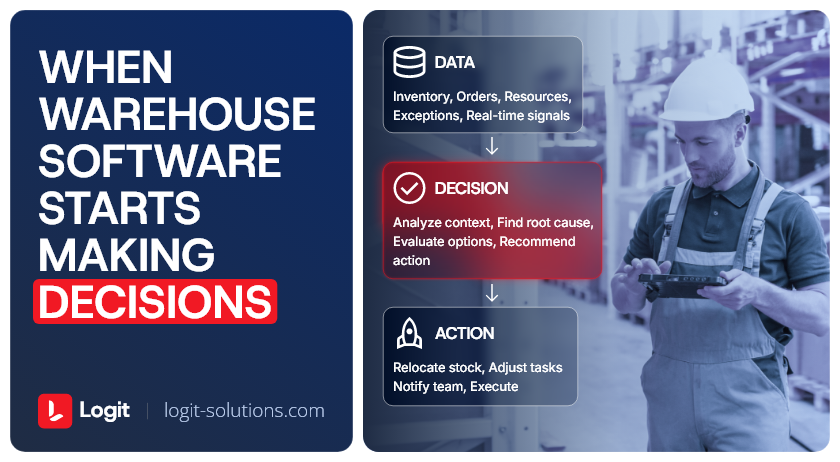
When Warehouse Software Starts Making Decisions
How AI agents are changing the role of WMS — from recording operations to interpreting context, recommending actions and, increasingly, acting on them.
For years, one of the main objectives of warehouse digitalization was visibility.
Companies invested in Warehouse Management Systems (WMS), barcode scanning, mobile devices, dashboards and system integrations to answer fundamental operational questions: What inventory do we have? Where is it located? Which orders are waiting? What has been picked? Where are the bottlenecks?
That visibility transformed warehouse operations.
But in 2026, another question is becoming increasingly important:
Once the system knows what is happening, what should happen next?
This question reflects a broader shift taking place across supply chain technology. Gartner identifies agentic AI among the major supply chain technology trends for 2026, reflecting a move toward systems that can increasingly support, and, within defined boundaries, participate in — operational decision-making.
The direction is becoming clear: warehouse systems are beginning to evolve from platforms that primarily record, control and display operations toward systems that can increasingly interpret operational conditions, support decisions and, within defined limits, initiate action.
Warehouses have more data than ever
A modern warehouse can generate thousands of operational signals during a single shift.
Inventory movements, receiving transactions, picking tasks, replenishment requirements, order priorities, cut-off times, labor availability, equipment status and exceptions may be continuously recorded across WMS, ERP, WES, automation and other connected systems.
The challenge is therefore changing.
In many operations, the problem is no longer a lack of information. It is the ability to interpret that information quickly enough to influence what happens next.
Consider a priority order approaching its shipping cut-off.
At first, it may appear to be a picking problem. In practice, the cause may sit somewhere else: replenishment has not reached the picking location, available stock is allocated to another order, workload has accumulated in one warehouse zone or another operational priority has consumed the available resources.
The information required to understand the situation may already exist.
But someone still needs to connect those signals, identify the real cause, evaluate the consequences and decide which action should take priority.
As warehouse complexity increases, this decision-making layer becomes increasingly important.
From systems of record to systems of decision
Traditional warehouse software was designed primarily to create structure and control.
A WMS records inventory, manages locations, directs warehouse tasks and ensures that predefined operational rules are followed.
Business intelligence and dashboards added another layer: visibility. Managers could monitor performance, identify deviations and analyze what had happened.
The next evolution adds something different: decision intelligence.
Instead of only displaying that a problem exists, emerging systems can increasingly evaluate the operational context surrounding that problem.
An order approaching its cut-off may trigger more than an alert. A system can potentially determine that the underlying issue is insufficient stock at the picking location, identify an available replenishment resource, evaluate competing priorities and recommend the most appropriate next action.
record → report → analyze
observe → understand → recommend → act.
The important change is not simply that warehouse software is becoming more automated.
It is that software is beginning to participate in operational decision-making.
Exception management may be one of the biggest opportunities
Warehouses rarely struggle because every process is failing simultaneously.
More often, performance is affected by exceptions.
A truck arrives late. Inventory is not where it should be. A picking location needs replenishment earlier than expected. A wave contains a shortage. One zone becomes overloaded. Equipment becomes unavailable. Customer priorities change during the shift.
Experienced warehouse managers and supervisors resolve situations like these every day.
Their value comes not only from seeing the exception, but from understanding what it affects and what should be done about it.
This is one of the areas where AI can create practical value.
Rather than requiring supervisors to continuously monitor multiple screens and determine which deviations matter most, intelligent systems can help identify exceptions, assess their potential impact and prioritize the situations that require intervention.
The objective does not need to be full autonomy.
In many warehouses, the more immediate opportunity is better decision support: allowing people to spend less time gathering information and evaluating routine situations, and more time on decisions where experience and judgment genuinely matter.
AI agents introduce another step
Agentic AI extends this development further.
An AI agent can potentially monitor a defined operational context, interpret information from connected systems and initiate a permitted sequence of actions.
The level of autonomy can vary considerably.
In one environment, an agent may identify a problem and recommend an action.
In another, it may prepare the action and wait for supervisor approval.
For routine, low-risk and reversible decisions, it may eventually be authorized to execute predefined actions independently.
This is already moving beyond theory. In January 2026, Manhattan Associates announced the commercial availability of AI agents embedded across its Manhattan Active solutions. Its warehouse examples now include agents that investigate wave shortages, support warehouse associates and identify labor imbalances, with recommendations or actions governed within the operational platform.
At the same time, the scale of expected adoption is significant. Gartner forecasts that spending on supply chain management software incorporating agentic AI will increase from less than $2 billion in 2025 to $53 billion by 2030. Gartner also predicts that 60% of enterprises using SCM software will have adopted agentic AI features by 2030, up from 5% in 2025.
The important question, however, is not how autonomous warehouse software can become.
It is where autonomy creates measurable operational value and where human judgment should remain in control.
Building AI also changes the questions you ask
This progression is not theoretical for Logit.
We are currently developing an AI agent and exploring in practice how operational data can be translated into faster, more consistent and more useful decisions.
The project is still in development.
That makes questions around context, permissions, human oversight, system integration and decision authority particularly relevant. They are not abstract questions that appear only after AI is introduced. They are design decisions that need to be addressed before an agent can move safely from analyzing information toward participating in real operational workflows.
That experience also reinforces something familiar from warehouse projects: the intelligence of the technology matters, but so does the operational foundation underneath it.
AI still depends on good warehouse fundamentals
Adding artificial intelligence to warehouse operations does not eliminate the requirements that have always made digital projects successful.
In fact, it makes them more important.
AI cannot reliably reason about inventory if inventory data is inaccurate.
It cannot prioritize warehouse work effectively if process rules are unclear.
It cannot understand the complete operational situation if critical information remains isolated across disconnected systems.
And it should not execute actions if permissions, responsibilities and escalation rules have not been defined.
Data quality is therefore becoming a particularly important part of AI readiness. Gartner's 2026 agentic AI forecast specifically points to supply chain data management, operations management, workforce AI readiness and network-centricity as areas that must evolve to enable AI-driven supply chains at scale.
The technology may be new.
The importance of operational discipline is not.
Integration is becoming part of intelligence
This development also changes the role of system integration.
Historically, integration was often viewed primarily as a mechanism for transferring information.
An ERP sends an order to the WMS. The WMS returns inventory or shipment information. A transport system receives shipping data.
In an increasingly intelligent warehouse, integration also provides context.
A WMS may know that an order is ready for picking. The ERP may hold its commercial priority. A transportation system may hold the carrier cut-off. The automation layer knows current equipment capacity. Labor information may indicate that one operational zone is already overloaded.
A useful decision may depend on several of these signals simultaneously.
No individual system necessarily holds the complete picture.
For companies considering AI in warehouse operations, this creates an important question:
Does the technology have access to enough operational context to make a good decision?
Without that context, adding AI may simply create another technology layer on top of fragmented processes and fragmented data.
Not every warehouse decision should be automated
The current attention surrounding AI creates a risk of treating autonomy itself as the objective.
It should not be.
The objective is better warehouse performance.
Some decisions occur frequently, follow relatively clear rules and have limited consequences if reversed. These are natural candidates for greater automation.
Others involve safety, unusual inventory situations, customer commitments or significant financial consequences. Human approval may remain essential.
This is why governance is becoming as important as capability.
Gartner's 2026 supply chain technology outlook groups the year's trends around three themes: autonomy and agency, specialization and intelligence, and trust and governance. Its agentic AI guidance also stresses the importance of appropriate human-in-the-loop controls, especially during early deployments.
A practical AI strategy should therefore not begin with:
How much of our warehouse can AI control?
A better question is:
Which decisions consume significant time today, which can be supported by reliable data, and where would faster or more consistent decision-making create measurable value?
That shifts the discussion from technology to operations.
From visibility to action
Warehouse digitalization has progressed through several stages.
First came the need to record what was happening.
Then came the need to make operations visible.
The next stage is increasingly about using that visibility to improve decisions while operations are still taking place.
WMS, automation, analytics and artificial intelligence are beginning to converge around that objective.
For Logit, this evolution builds on more than two decades of warehouse and WMS experience. Across different technologies, industries and operational models, the same principle continues to apply: advanced technology cannot compensate for poorly defined processes, unreliable data or disconnected systems.
AI changes what warehouse software may be capable of doing.
It does not change the importance of getting those foundations right.
If anything, it makes them more important.
And that leaves warehouse and logistics leaders with a useful question to consider:
Which decisions in your warehouse should still require someone to look at a screen, connect the information and decide what happens next?
Sources & Further Reading
- Gartner — Forecasts SCM Software with Agentic AI Will Grow to $53 Billion in Spend by 2030 (April 7, 2026)
- Gartner — Identifies Top Supply Chain Technology Trends for 2026 (June 30, 2026)
- Manhattan Associates — Announces Commercial Availability of its AI Agent Workforce (January 8, 2026)
- Manhattan Associates — Agentic AI Has Arrived in WMS (June 25, 2026)
- Manhattan Associates — Waypoints Supply Chain Execution 26.2